
Softball Arm Stretches to Keep Your Throwing Arm Healthy
The best arm stretches for softball players keep the shoulder, lats, and forearms loose so the throwing arm can move freely and recover between outings. Use dynamic stretches (like wall circles, foam rolling the mid-back, and snow angels on the foam roller) before you throw, and static stretches (like a lat stretch and wrist flexion and extension stretches) after. Stretching consistently helps a healthy arm stay healthy, but it won't fix an injury, so persistent throwing pain should be evaluated by a sports physical therapist.
If you play softball, your throwing arm works overtime, and it’s not a “natural movement” (like the swinging of your arms when you walk is).
Every windup, every throw across the diamond, every pitch loads your shoulder, elbow, and forearm, over and over again. And here's the thing - tightness and arm fatigue might be common in throwing athletes, but constant pain isn't something you should just push through.
Stretching is one of the simplest and most effective things you can do to keep your throwing arm loose, mobile, and ready to perform. I walk my athletes through these exact stretches in the clinic, and the players who stay healthiest are almost always the ones who make arm care part of their routine (not something they scramble to do once it already hurts).
Below are the arm stretches I recommend most, with a video demo of each so you can see exactly how to do them. I've split them into dynamic stretches to do before you throw and static stretches to do after.
Dynamic vs. Static: Timing Matters
Here's something a lot of players get backward - the kind of stretching you do depends on when you're doing it.
Before you play or throw, you want dynamic movement. These are stretches where you're actively moving through a range of motion, which warms the tissue up and gets your arm ready to go. Holding long, deep stretches on a cold arm right before you throw can actually leave you feeling loose in the wrong way.
After you play, or on a recovery day, that's when static stretches (the kind you hold) do their best work. Hold each one for 20 to 30 seconds, breathe, and never force it into pain.
Now, let's get into the stretches.
Dynamic Stretches — Do These Before You Throw
Wall Circle Stretch (Pec Stretch)
Start standing with a staggered stance next to the wall - the foot closest to the wall is placed forward with the border of the foot spaced about 6 inches away from the wall, the back foot can be placed equal with the body (or back further for more intense stretch)
You’re going to make a circle with the arm closest to the wall:
Stand tall through the spine and shoulders
Keep palm facing the wall the entire time
Reach forward, up, and then back until you complete a circle (flip your hand at the bottom before starting the circle again)
Turn your head to follow your hand as it moves around in a circle
Perform 10 on each side
Modification: If this stretch is too intense, then start with the body and foot further from the wall
Do not lean your shoulders away from the wall
Foam Roller for the Mid-Back
This is not the time to use your super hard or knobby foam roller. Choose one that has a little give to it, or alternatively, wrap your foam roller in a bath towel (you might need some tape) to provide extra cushion.
Start with the foam roller placed horizontally across the midback between the shoulder blades
Place hands behind your head for support, keep knees bent and feet flat on the floor
Remember to breathe during the exercise
Lift your hips slightly off the floor
Roll up and down the midback for 30 seconds
Modification: If this is too intense, use a rolled up hand towel instead of a foam roller at several points along the midback and move elbows in and out to mobilize the back
Head is relaxed on the floor, hands behind the head
Place towel at the area where neck and upper back meet
Keep knees bent and feet flat on the floor
Bring elbows together (inward) and apart (outward) 10 times
Move to the next segment and repeat
Foam Roller Snow Angels
You’ll want a long foam roller for this one - or start with a couple bath towels rolled together lengthwise to create a makeshift foam roller at home.
Place the foam roller (or towel foam roller) vertically along the spine ensuring that the head and tailbone are resting on the foam roller
Knees bent and feet placed flat on the floor
Reach hands up together up toward the ceiling, then overhead, and out to the side as you bring them down towards your hips
Try to keep hands as close to the floor as possible during this movement
Repeat 10 times
Modification: If you are too tall for this to work on a long foam roller, make a headrest using a yoga block or folded towels to support the head and neck at the same height as the foam roller.
Static Stretches — Do These After You Throw
Step-Back Lat Stretch
You can use a cabinet at home or barbell placed on a rack for this stretch. Alternatively you can also perform it on a chain link fence immediately after throwing.
Start with hands placed on a cabinet, barbell, or chain link fence at the height of your shoulders (or slightly higher)
Step back with one leg
Hinge at the hips - pushing your hips backward and allowing your chest to drop toward the floor
If you are comfortable with it, lean back gently into the back leg to feel a stretch through the back and sides of the body. Make sure you have a good grip on your surface. Only push to mild discomfort.
Hold for 30-60 seconds, then switch foot position.
You should not be feeling any numbness, tingling, or pain down the legs. Stop immediately if you have these symptoms.
Wrist and Finger Extension Stretch on the Wall
This one is fairly straightforward.
Stand about an arms length away from the wall
Place hands forward on the wall starting at the level of your head
Keep your hands flat on the wall and elbows straight
Slide hands down the wall until you feel a stretch through the hands and forearms. Only push to mild discomfort.
Hold for 30-60 seconds, repeat for a total of 2 sets
Wrist Flexion Stretch (Arm Extended)
Sit or stand for this one.
Extend one arm straight out in front of you at shoulder height
Position the hand so that the palm is facing the floor
Gently use your other hand to bend your wrist and pull your hand downward (so that your palm faces you) until you feel a stretch through the top of the forearm. Only push to mild discomfort.
Hold for 30-60 seconds, repeat 1-2x on each side.
How Often Should You Do These?
Daily is ideal during the season, even just a few minutes a day. A simple plan: run through the dynamic stretches as part of your warm-up before you throw, and do the static stretches after you're done or on your off days. That's it. Consistency beats intensity here every single time.
When Stretching Isn't Enough
I want to be clear about something. Stretching keeps a healthy arm healthy. It does not fix an injury.
If you've got pain that won't settle with rest, pain that shows up every single time you throw, numbness or tingling down the arm, or a drop in velocity you can't explain, those are signs to get it checked out, not stretch through. Here's my policy - if in doubt, get it checked out. Always.
Throwing injuries are so much easier to handle early. Pushing through arm pain is how a minor issue turns into one that costs you a season.
You also need to be strength training. Learn more about softball-specific strength training here.
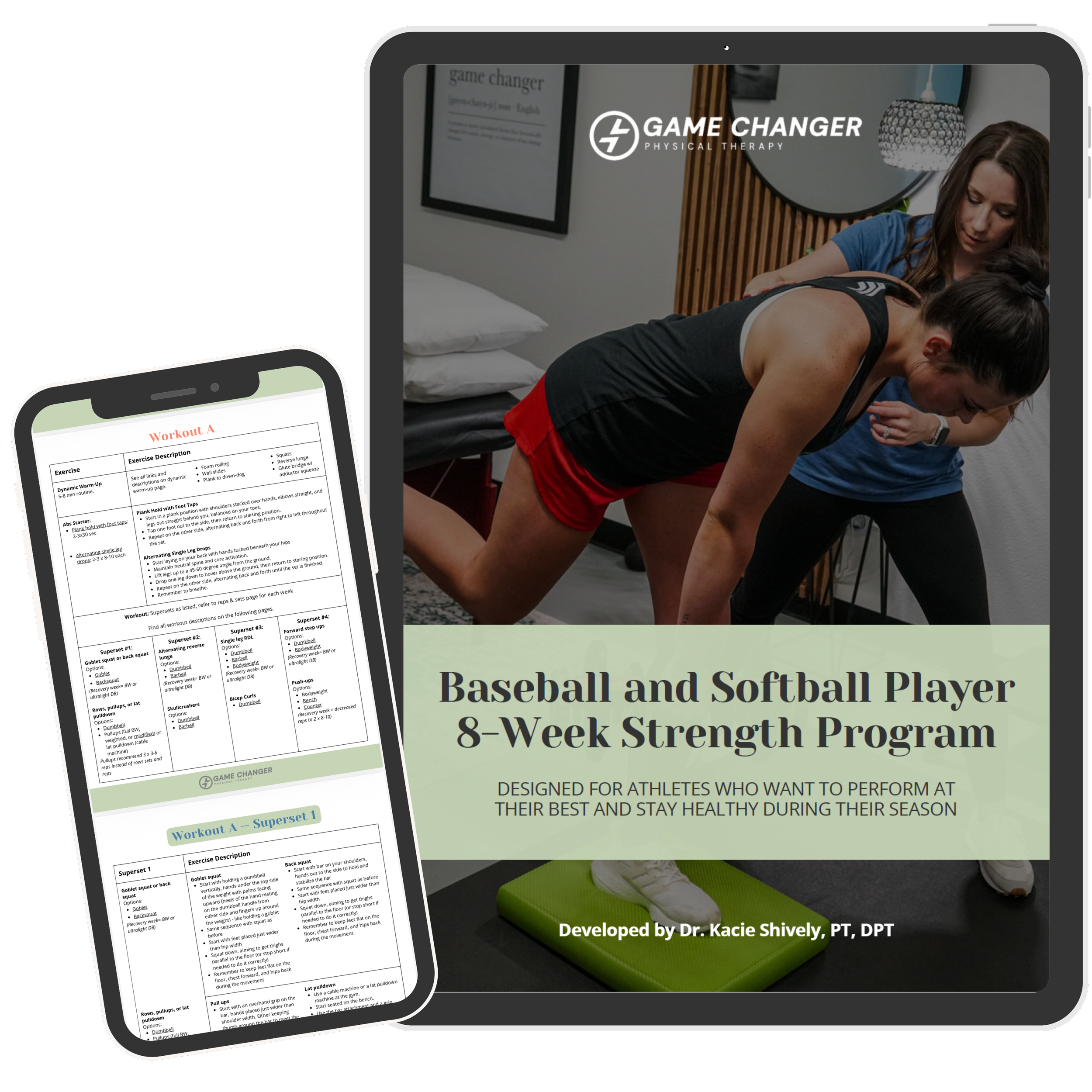
Want a Strength Plan Built for Throwing Athletes?
My 8-Week Strength Program for Baseball and Softball Athletes is a ready-to-follow plan. It builds rotational power and shoulder and hip stability, and it helps you stay durable through a long, repetitive season. There's no guesswork and no adapting a generic gym plan. You just show up and do the workout.
What's included:
3 full-body strength workouts per week (45–55 minutes), at home or in the gym
Built-in progressions and modifications so it meets you where you're at
Written and video tutorials for every exercise
Bonus foam rolling, mobility, and quick 15–20 minute strength routines
Only $147 → [Get the Program]
Where to Find a Sports Physical Therapist in Kennewick
If you're local to the Tri-Cities and you're dealing with arm pain, or you just want to build a routine that keeps your throwing arm healthy all season, I'd love to help. I work with softball and baseball players (and athletes of all kinds) on both injury rehab and recovery, including manual therapy, dry needling, scraping, cupping, and more, right here in Kennewick.
If you want to start with a personalized assessment, let's talk.
How to Work With Me From Anywhere
There are a few virtual options to work with me and more to come in the future. To be notified when I open up virtual coaching and customized strength programming, join the interest list below!